
We spent two nights at the Cantilever Hotel at Ranier, MN. This is a very small town; just a few houses, cabins, a hotel, a busy USA-Canada railroad running through it, and some stores and a pub. We arrived early enough to walk around the town and take a few photos. On the way back to the hotel, just a block away we saw a hefty looking machine, just sitting at the corner of a building. I’m fascinated by machines. I want to know what they do and how they work. And this one was intriguing.
We stopped and looked it over carefully, and took some photos. All the time wondering what it was. On the header was a stamped name – Linotype. Within minutes a man appeared, and seeing our interest in the device, proceeded to explain its function and history. His name is Phil Paulbeck. And he is a fixture in this small town. Phil is instrumental in preserving any part of the history of Ranier. And so the story unfolded…

The Story Behind the Machine
It started with Ted Hall. Ted Hall was a reporter from Connecticut. He came to Ranier, Minnesota with his girlfriend. He was retired. Soon after his arrival he created the Rainy Lake Chronicle. He was already a renowned writer and editor. He wrote and edited the Rainy Lake Chronicle from 1974 to 1980.
West Coast Rare Books states:
Hall, A Rainy Lake Chronicle.
Hall, Ted. A Rainy Lake Chronicle. Ted Hall wrote this. Thomas [his son] Hall printed this. All in Ranier, Minnesota. First Edition. Ranier, MI, Rainy Lake Printing House, 1989. 21 x 14 cm. 71 pages. With small B&W drawings. Original dark blue cloth with gilt title on front board and spine. Inside original dust jacket, now inside clear archival jacket. Very good in very good dust jacket. Ex Libris and gift inscription on end papers. Edges and dust jacket age darkened and mildly stained (see images). Internally bright and clean.
Language: English
Inventory Number: 103633AB
Our price: EUR 35
Ted Hall died in 2004 at the age of 82, leaving the Daily to his son Thomas, along with all his possessions. Ted Hall had a boat, which he navigated to the Great Lakes and then transported from Duluth, Minnesota to Rainy Lake.
Phil Paulbeck – Preservationist
One of the possessions that Ted left behind was a refrigerated box car which he built. It was used to carry fish and other refrigerated items to markets via the nearby railroad. Phil Paulbeck bought the 38’ refrigerated box car. It was going to be demolished. Phil paid $900 for the crate.

The son, wanting to get rid of his father’s boat, which was in the process of being restored and was in pieces, credited Phil’s purchase of the refrigerated crate towards the asking price for the boat, $3,400, which was much more valuable than the price offered, so Phil got the boat for $2,500.00.
More About Ted Hall
April 25, 2004 by Quetico Superior Wilderness News
Incomparable Journalist Came Home To Rainy Lake, Joined Ober’s Wilderness Crusade
by Diane Rose, Wilderness News Contributor

I didn’t know Ted Hall. But I really wish I had. I have always thought that if I could spend some time with a departed historical figure, it would be Mark Twain – to revel in his unique humor, adventurous spirit and tell-it-like-it-is approach to religion, politics and every other topic under the sun. Ted Hall had all of that, plus a dedication to preserving the natural magic of the boundary waters area surrounding his favorite place in the world: Ranier, Minn., and Rainy Lake.
Edward (Ted) Hall, who died [September 23 2004,] at age 82, is known for several things. He was an honest, tenacious and gifted reporter and writer who grew up in Frontenac, MN, near Red Wing but quickly moved up to journalism’s big leagues. He worked on a series of New Jersey newspapers, covering stories such as the Attica prison riots in 1969, until he refused an order to kill a story involving a key figure in a sensational murder trial. He was fired, and two days later was hired by Time magazine as a political editor. He also worked as a consultant to NBC Television News. In the early 1970s, tired of the East Coast rat race, he purchased a lobster boat in Boston and sailed with his son Thomas to Duluth, then trucked the boat to Ranier, where he had spent his boyhood summers starting at age 9. In a 1979 interview with the Bergen (NJ) Evening Record, he explained: “It was always in the back of my mind. I wanted to get back to this part of the country, my country.”

Life in Ranier inspired Hall’s most famous creation, a boisterous weekly newspaper called The Rainy Lake Chronicle, of which he was “editor et cetera” from 1974 through 1980, when he stepped down to write books. The paper, which was published until May 1982, covered local politics in an energetic, detailed, unflinching style that ruffled many feathers and got local citizens interested in public affairs. His philosophy: no story was too small to be an important story. Stories about and passion for the Northwoods wilderness often filled Hall’s “Drumbeat” column. The Chronicle soon had a circulation of 1,700 people (with total readership estimated at 10,000) that included readers from across the United States in addition to the 255 residents of Ranier. Photos from his Chronicle days invariably show Hall peering out from under his thick shock of hair, wearing a flannel shirt and puffing on a pipe. His salary was $5,000 a year.
Hall also is known as a close friend of conservationist Ernest Oberholtzer, whom he met while growing up in Frontenac. Oberholtzer, who was instrumental in the movement to preserve the Boundary Waters wilderness, hired young Hall to work at Mallard Islands in Rainy Lake during the summers. Although he never took credit for it, Hall later worked to fight commercial development and helped bring the islands under the protection of the Oberholtzer Foundation. They are now known as Ober’s Islands, and Hall loved to spend time there in the summers. He recently was named an emeritus member of the Oberholtzer Foundation board.
In 1983, Hall wrote the following in a commentary piece for the Minneapolis Star and Tribune about Oberholtzer: “Let us simply note that through all that long battle, Ernest Oberholtzer’s Mallard Island in Rainy Lake was the real headquarters – the touchstone – for the battle, and upon his death in 1977 at the age of 93, friends steered his island home into the foundation he had set up a dozen years earlier to carry on his quiet work as a teacher, friend of wilderness and Indian, friend of art and literature and music and, above all, friend of all people.”
Hall’s sister, Sila Flueger of Red Wing, said her brother’s love of the wilderness stemmed from his friendship with Ober. The Rainy Lake Chronicle made people all over the United States aware of the Boundary Waters area and encouraged many of them to visit, she said. Flueger said Hall often talked about moving to the city but he always felt compelled to return to Rainy Lake. In the mid-1980s Hall and his second wife, Rosalie “Rody” Hall of Minneapolis, sailed the lobster boat down the Mississippi River to New Orleans, where they sold the battered old craft. In 1992, Hall published a book recalling his childhood in Frontenac, titled “Growing With the Grass.” In 1993, while he was living in Minneapolis next to Lake of the Isles, Hall was interviewed by the Rochester Post-Bulletin and said of his home: “It’s partly country. There is some space around.”
In May 1979, Hall wrote an article for Mpls.-St.Paul Magazine called “The Granite, Trees, Blue Sky and Mood of Rainy Lake.” He includes a scathing critique of International Falls, which is “keen on hockey, women’s softball, curling, afternoon girlie shows and both social drinking and unsocial drinking. The approaches to the city from the outer world are adequately stocked with brand-named motels and junk food stands.” He then moves on to a travelogue that covers the town of Ranier, Rainy Lake itself and even Voyageur’s National Park. Hall concludes: “These are the things worth seeing and doing – the bait. All the while, Rainy Lake is working that spell that will bring the visitor back – maybe for good. To repeat the warning: Rainy Lake is more than granite and trees and tall blue sky. It is a mood. It’ll get you – if you’re worth getting.”
Flueger, reminiscing about their childhood, said she and her brother used to go up to Oberholtzer’s place at Rainy Lake the day school was out. “Ted took a lot of canoe trips with Ober,” she said. “That was his favorite time – when he
was out on Rainy Lake and could keep an eye on everything that was going on.” Flueger also recalled how newspapering was in their family’s blood right from the start. Their father had been in the newspaper business and she worked as a society editor at the Red Wing newspaper at one time. “Ted started a little tiny magazine (it was called Old Man River) when he was 7 years old,” she said, laughing. “He made me the printer’s devil; I was only 2 at the time. He was a terrible tease.”
I wish I’d had the chance to spend a day with Ted Hall.
This article appeared in Wilderness News Spring 2004
More About the Linotype Function and History
The Gist:
- Invented by Ottmar Mergenthaler, first used commercially by the New York Tribune in 1886
- It was a “line casting” hot-metal typesetting machine — manufactured and sold by the Mergenthaler Linotype Company and related companies Wikipedia
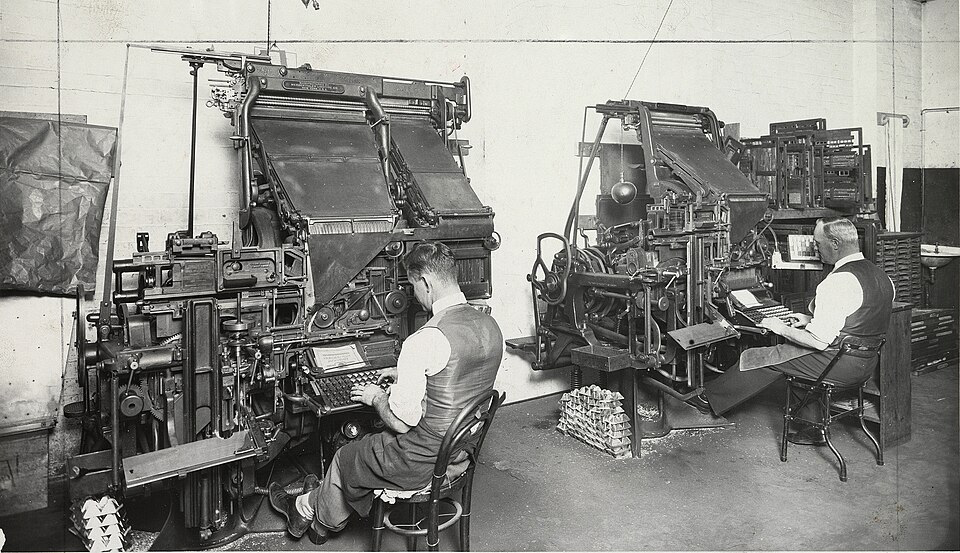
- Before it, compositors set type by hand one letter at a time, and a single newspaper page could take 2-3 days to compose; the Linotype cut that down to about an hour Woodtype
- It has four main parts: a magazine, keyboard, casting mechanism, and distribution mechanism — the operator works the keyboard to compose lines, and the rest runs automatically once a line is complete Wikipedia
- A matrix is a small rectangular piece of bronze with a single letter, number, or symbol engraved on its edge; matrices drop into place to form a line, hot metal is forced into the mold, and it casts a line of type Iowa PBS
- It’s largely obsolete now, though at least one Brazilian newspaper, O Taquaryense, still uses Linotype and traditional typographic printing methods.
Translation from an excerpt from Wikipedia, about Linotype used at O Taquaryense:
Marinoni printer and linotype machine in the graphic workshop of O Taquaryense The newspaper maintained, for more than a century, the manual composition system with mobile types of lead, in which each letter, number and symbol was manually organized for the assembly of the pages. In 2021, a linotype was incorporated into the machinery, allowing a hybrid composition system, which began to combine traditional manual composition with mechanical linotype, preserving the historical production method. 7 Printing continues to be carried out on the French printing press Marinoni Universelle, acquired in 1910 and formerly belonging to Correio do Povo. 3 It is considered the only active newspaper in Brazil that still uses typographic printing as the main production method, and is also one of the last in the world to maintain this system continuously, alongside periodicals such as the French Le Démocrate de l’Aisne and the North American The Saguache Crescent. ~Wikipedia
More Details About the Linotype

Doing some research, this looks like a well-preserved (if rusty/dusty from storage) Mergenthaler Linotype — you can see:
- The magazine (the large tilted metal box at top) that holds the brass matrices
- The keyboard at the bottom with the distinctive black, white, and blue keys (blue keys were typically for lowercase letters, black for capitals/figures, white for spacing and special characters)
- The elevator/distributor mechanism in the middle where matrices would travel back up after casting
- A small nameplate reading “Linotype No. ___” near the top left of the mechanism, and what looks like a “Mergenthaler Linotype” builder’s plate
- It weighs about 3000 lbs.
The Linotype History
The problem it solved
Before the Linotype, type was set by hand — a compositor picked individual metal letters one at a time out of a case and arranged them into lines, then redistributed every single letter back into the case after printing. At the time of the Civil War, typesetting was the second most common occupation in America, surpassed only by farming, and it was done almost entirely by hand. A single newspaper page could take 2-3 days to compose by hand. MuseumofprintingWoodtype
What it changed
Ottmar Mergenthaler’s machine let an operator type on a 90-character keyboard, which released brass letter molds (matrices) that assembled into a line; molten lead was then poured in to cast that whole line as one solid metal “slug.” The machine has four sections — magazine, keyboard, casting mechanism, and distribution mechanism — and once a line is composed, the casting and redistribution happen automatically. Casting a full line instead of setting individual letters is where the name comes from (“line o’ type”). That cut newspaper composition from days down to about an hour, and book publishing went from months to weeks. The New York Tribune became the first newspaper to adopt it in 1886, and papers worldwide quickly followed. Wikipedia
Its significance is hard to overstate: outside of Gutenberg’s invention of movable type, no single machine has had as much impact on printing as the Linotype. By making mass-produced newspapers and books dramatically cheaper and faster to produce, it’s credited with helping fuel the explosion of newspapers, literacy, and mass media in the late 19th and 20th centuries. Museumofprinting
Why it lasted so long
The Linotype was essentially the industry standard for nearly seventy years. A few reasons for that longevity: Museumofprinting
- It was simply the best available technology for a long time — nothing else matched its speed and reliability for setting body text at scale
- Manufacturing spread internationally (US, UK, Germany), competitors like Intertype and Linograph emerged using the same basic principle, and the machines kept getting incrementally improved — new fonts, sizes, and character sets for languages like Cyrillic and Arabic Docalign
- The printing industry is capital-intensive and conservative — papers had entire production workflows and skilled unionized labor built around hot-metal typesetting, so switching was disruptive and expensive
- Early alternatives weren’t good enough yet: the first phototypesetting patent dates to 1925, but it took until around 1950 for that technology to reach production printing environments, and early phototype quality wasn’t great Linotype
How it declined
Phototypesetting used photographic images of letters instead of cast metal, allowing more fonts and sizes, and digital typesetting later took that further with computers generating and manipulating text — both offering more flexibility, speed, and lower cost. The shift was gradual rather than sudden: major US newspapers mostly retired Linotype during the 1970s and 80s, and famously the New York Times didn’t make the switch until 1978 — a transition documented in a well-known film of the paper’s last night of hot-metal typesetting. Linotype’s own manufacturing plants closed by the 1970s-80s.
A few holdouts remain even now — The Saguache Crescent in Colorado is reportedly the last U.S. newspaper still using Linotype, and Le Démocrate de l’Aisne is the last in Western Europe. Beyond that, they mostly live on in museums and with hobbyist preservationists — which sounds like exactly where the one in my photo has ended up. Wikipedia
A lengthy article, and most likely only interesting to a few. Yet there is history here. And now you know about this printing machine’s history, and how it single-handedly, helped to spread the word, in newspapers, brochures, and books, across the globe, for over 100 years.
Let me know if you liked the article. Did it resonate with you? Thanks for reading.
Randino
Credits: Much of my research about the Linotype and Ted Hall was done with the help of Claude AI, Wikipedia, and Duck-Duck-Go searches and AI.







Leave a Reply